
Rodent Removal in the Chisholm Trail Corridor
The Chisholm Trail Parkway opened in 2014 and the pasture along it in southwest Fort Worth has been turning into brick subdivisions ever since. Nobody pays for the inspection, and the phone is picked up day or night.
- Free roofline and garage inspection
- New slab houses on old pasture
- TDA-licensed contractors routed
The corridor is the newest housing in Fort Worth
Southwest Fort Worth grew a road before it grew houses. The Chisholm Trail Parkway, a toll road running from downtown toward Cleburne, opened in 2014, and the ranch land on either side of it in the 76123 zip code and out toward Crowley has been platted into subdivisions in the years since. The houses are brick-veneer single-stories and two-stories on concrete slabs, with composition shingle roofs, ridge vents and blown insulation, and the streets sit in Fort Worth, Tarrant County, a short drive from Benbrook and Burleson.
A house this new has few openings, and the ones it has are all at the roof and the garage. The ridge vent ends, the gable vents, the seam where the builder soffit meets the brick, the roof-to-wall returns on a two-story, the weep holes along the bottom course and the corners of the garage door seal make up the whole list. None of them was finished to the quarter inch that UF/IFAS gives as the rat-proofing standard, and the inspection checks all of them in an hour.
Every cleared field sends rats to the nearest street
The pressure here comes from the land being built on. The subdivisions along the parkway still back onto working pasture and hay fields, and each phase of grading pushes the rodents that lived in the grass and the fence rows toward the houses already standing. Roof rats follow fence lines and utility drops, per UF/IFAS, and a privacy fence that runs from the field edge to the corner of a garage delivers them to the soffit. Norway rats stay low and burrow along the slab edge and under air-conditioning pads.
Calls ramp in the fall and peak in January and February when the animals move into the attic for warmth, and a summer attic above 130 degrees pushes any already inside down into the garage and the wall voids. Sealing before October is the single most useful thing a homeowner on the pasture edge can do, and rodent exclusion on a house like this is a short list of points closed once.
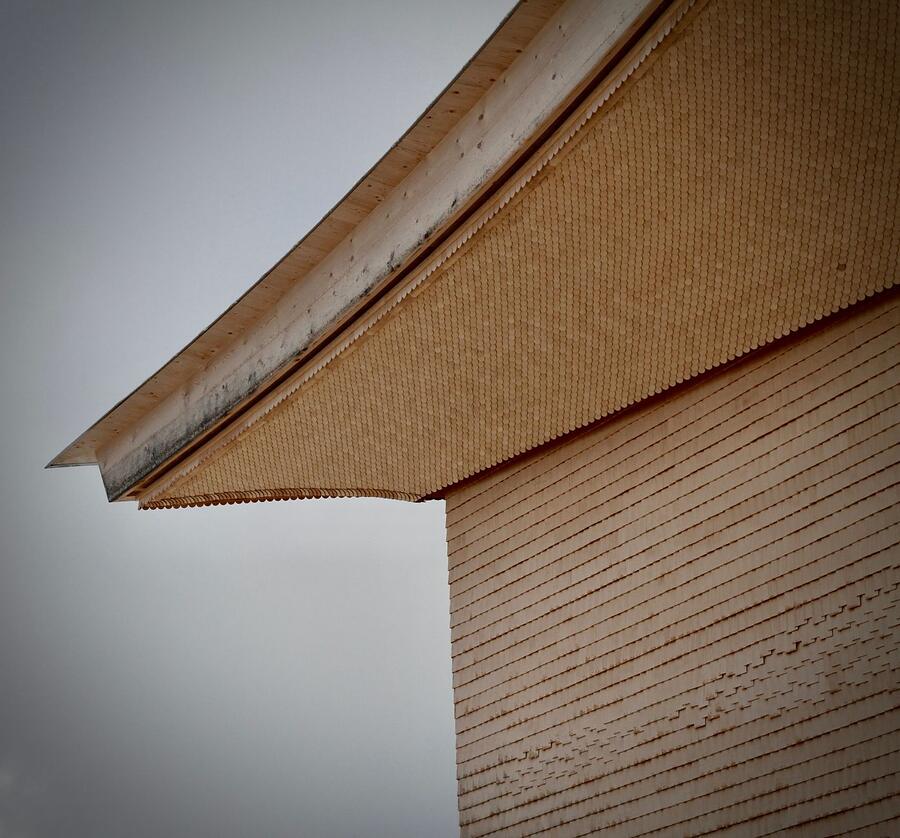
A representative soffit seam on a Chisholm Trail house
The seam where a builder-grade soffit meets the brick veneer is the most common opening on a production house. The soffit panel stops short of the brick, the frieze board behind it is nailed loosely, and the gap runs the length of the eave at a size a roof rat walks through without slowing. The fix is a strip of hardware cloth or sheet metal fitted along the seam from the attic side or from a ladder, and it goes on the quote as one named line. The free inspection photographs the seam and every vent, roof rat removal traps the attic while it is closed, and the contact page has the hours.
The route in from the sewer line
How a rat travels a drain into a house.
Video: How do rats get out of the sewers and into your home?, from BEEKIND Pest Control.
Why Chisholm Trail homeowners call this number
A subdivision still being built changes the timing of the work, and these three points explain how it is handled here.
New houses get a short, photographed list
With no crawl space and few penetrations, a Chisholm Trail inspection is the ridge and gable vents, the returns, the soffit seam, the weep holes and the garage seal. The contractor we route checks each from the roof and the attic and photographs it, so the quote names the points instead of quoting the house.
Rat-proofing standard of a quarter inch, UF/IFAS Extension
Sealed ahead of the next phase
Grading behind the fence sends the field rats to the nearest street, and the fall migration into attics follows. The sealing is priced as its own line so a homeowner on the pasture edge can book it in September without any trapping attached.
Full-home exclusion $500 to $2,500 nationally, HomeGuide 2026
A license number to check
Every contractor routed into the corridor holds the Texas Department of Agriculture structural pest control business license that covers rats and mice. The TPCL number is on the department current-license list, and checking it takes a minute.
Structural Pest Control Service, Texas Department of Agriculture
A common Chisholm Trail call
The situation: A couple in a single-story brick house built in 2019 on the last street of a subdivision off the parkway hear something in the garage ceiling in early February, then droppings turn up on top of the water heater. The hay field behind the fence was graded for the next phase in January.
What gets done: The free inspection finds the soffit seam open along the back eave, a ridge vent end plug missing above the garage, and a chewed corner on the garage door seal. Roof rat droppings run along the attic top plate above the garage. The contractor we route closes the seam in sheet metal, plugs the ridge ends, screens the weep holes above the garage and replaces the seal, then traps the run for a week with the ridge as the last opening.
How it turns out: Two roof rats in the first three nights, nothing after the fifth, and the ridge closed on the second visit. The quote listed the seam, the ridge, the weep holes and the seal as separate sealing lines beside the trapping line.
Questions from the Chisholm Trail corridor
What owners of the southwest subdivisions ask before booking.
Call (817) 710-2756Does a builder warranty cover rats getting in?
Ask the builder, because the answer varies, and expect the answer to be that rodent entry is excluded. What the builder does owe on a new house is a soffit and roofline finished to its own standard, which is rarely a quarter inch. The inspection report lists each opening with a photograph, and homeowners have used that list to ask a builder to close a seam under warranty before paying for exclusion. The sealing that holds is steel either way.
Why do I hear them in the garage in summer and the attic in winter?
Because of the heat. A Fort Worth attic passes 130 degrees on a summer afternoon, and rats already inside move down into the garage, the wall voids and the space behind appliances, where the noise is heard at a different height. In the fall they move back up into the insulation for warmth, and the calls peak in January and February. The animal is the same; the sealing is at the roofline either way.
What keeps rats away permanently on a new house?
A roofline and garage with no opening over a quarter inch, which on a production house means a handful of points closed in steel. Repellents and ultrasonic plugs do nothing about the seam, and UF/IFAS notes a roof rat ranges about 150 yards from its den, so the field behind the fence keeps supplying animals for as long as the soffit is open. Once the seam, the vents and the seal are closed the pressure has nowhere to go.
What does this cost on a house like this?
Usually toward the lower end of the national bands. HomeGuide 2026 puts trapping and removal at $250 to $1,200 and full-home exclusion at $500 to $2,500 nationally, and a single-story slab house with a soffit seam, two vents and a garage seal sits near the bottom of the exclusion band. The free inspection produces the written quote with each line separate.